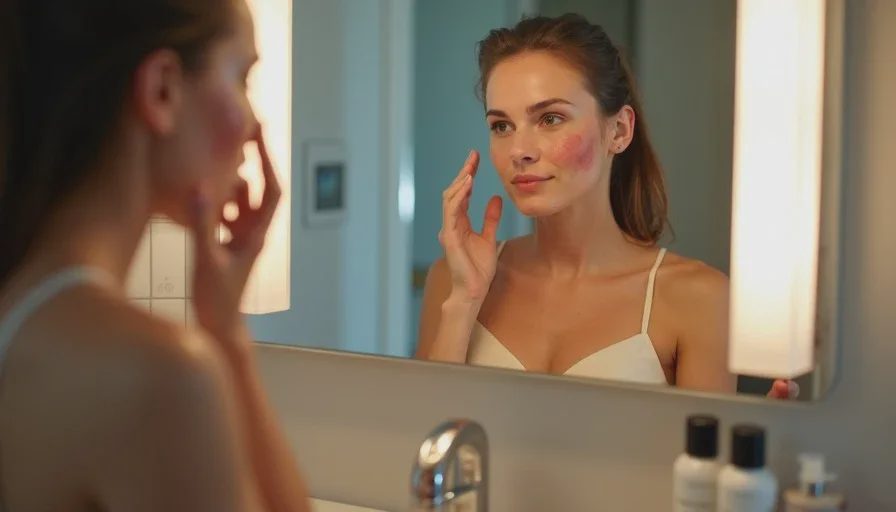
It is 11 PM. You bought a concealer, a tinted moisturizer, and a cream blush from a drugstore you had never visited, in a city you do not live in, because your bag was lost and you had a meeting in the morning. You applied them in the hotel bathroom. By midnight, your cheeks were warm. By 1 AM, they were itchy. By 3 AM, you woke up with a tight, stinging band across your jawline and a texture under your fingertips that was not there before.
Now it is 7 AM. You have four hours before you need to be in a room with other people. Your skin is reactive, inflamed, and possibly peeling. And you have no idea whether the damage is a passing irritation or the beginning of a week-long flare.
This is not a "best products for sensitive skin" article. This is a salvage protocol for the morning after a product reaction—a step-by-step order of operations for reducing damage, calming the skin, and deciding what to put on your face before you walk out the door.
Why the Morning After Is the Critical Window
A contact reaction does not peak the moment you notice it. It escalates.
When a reactive ingredient contacts the skin—a fragrance, a preservative, a botanical extract, an alcohol, a chemical sunscreen filter—the immune system mounts a delayed response. The initial application may produce nothing. The reaction typically develops over 24 to 72 hours, which is why the itch started at midnight and the stinging arrived at 3 AM. The inflammatory cascade is still running when you wake up.
This matters because what you do in the first two hours after waking determines how long the reaction lasts. Two mistakes extend a three-day flare into a ten-day one:
Mistake 1: Applying makeup over the reaction. Coverage feels like the solution. It is the opposite. Makeup traps the irritant against the skin, blocks the barrier from repairing, and adds new potential triggers on top of an already-compromised surface.
Mistake 2: Treating the reaction as acne. A reactive flare often presents as small bumps, texture, and redness—which looks like a breakout. The instinct is to reach for salicylic acid, benzoyl peroxide, or an exfoliating toner. On inflamed, barrier-compromised skin, these are accelerants. They will strip what is left of the barrier and turn a surface reaction into a raw, cracked one.
The salvage protocol exists to prevent both mistakes.
Step 0: Triage—Identify What You Are Actually Dealing With (5 Minutes)
Before you touch your face, look at it in the best light available. Then answer three questions.
Question 1: Where is the reaction?
Only where you applied the new product. This is the most likely scenario and the most treatable. It is a contact reaction to a specific product.
Across the full face, including areas you did not apply product to. This suggests a systemic reaction, an airborne allergen, or a reaction to the hotel bedding or water. Treat it more conservatively and consider whether the trigger was the product at all.
Around the eyes, lips, or mouth only. Stop. If there is swelling of the eyelids, lips, or tongue, difficulty breathing, or hives spreading beyond the face, seek medical care immediately. This is not a salvage scenario. This is a medical one.
Question 2: What does it feel like?
Itchy, warm, slightly tight. This is irritation or early contact dermatitis. Salvage protocol applies.
Stinging, burning, raw. This suggests barrier disruption with nerve involvement. Be extremely gentle. Do not apply anything with water alone and expect it to feel good—water can sting on a compromised barrier. Use a barrier cream first.
Peeling, flaking, cracking. This is moderate barrier damage. Hydration and occlusion are the priority. No actives of any kind.
Small bumps, texture, no itch. This may be a comedogenic response (pore clogging) rather than a contact reaction. The timeline is different—comedogenic breakouts appear over days, not hours. Treat conservatively and do not extract anything.
Question 3: How severe is the visible redness?
Faint pink, warm to the touch. Mild. Salvage protocol will likely resolve it in 24–72 hours.
Clearly red, warm, slightly raised. Moderate. Salvage protocol plus patience. Do not wear makeup if avoidable.
Deep red, swollen, hot, painful. Severe. Do not apply anything except a plain barrier cream and cool compresses. Consider seeing a pharmacist or a clinician.
The rule: If the reaction is severe, painful, or involves the eye area, the salvage protocol is not the answer. Medical care is.
Step 1: Strip Everything (First 30 Minutes)
The first action is subtraction, not addition.
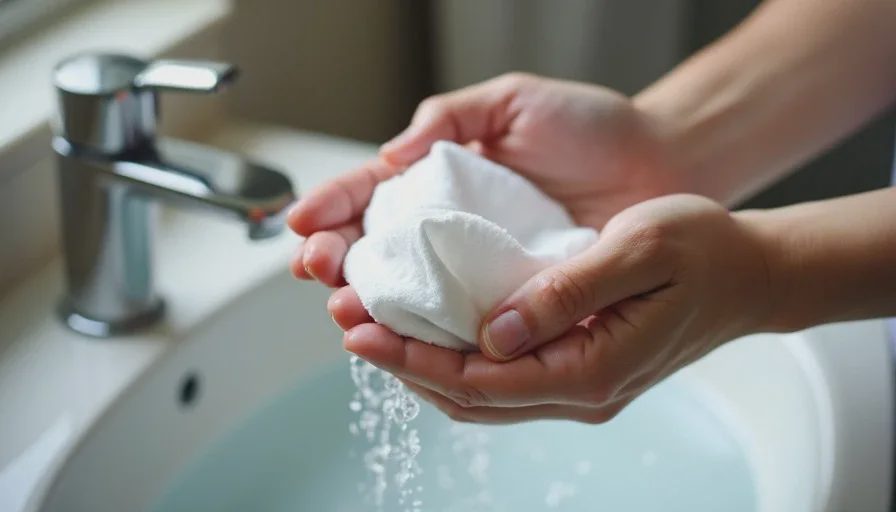
Wash with lukewarm water only.
Do not use cleanser. Do not use micellar water. Do not use a cleansing wipe. Every one of these contains surfactants, preservatives, or fragrances that can add to the reaction. Lukewarm water, hands only, 20 seconds. Pat dry with a clean, soft tissue—not a hotel towel, which may carry detergent residue.
If your skin stings on contact with water, that is a signal that the barrier is significantly compromised. In that case, do not rinse. Instead, move directly to the barrier cream step and clean the skin later, once the barrier has begun to recover.
Do not exfoliate. Do not use a washcloth. Do not scrub.
No physical exfoliation. No chemical exfoliation. No acids, no enzymes, no scrubs, no cleansing brushes. Exfoliation removes the dead surface layer—which is precisely the layer currently protecting the raw skin underneath.
Do not apply the product that caused the reaction again.
This sounds obvious. It is not. If the reaction presented as small bumps, the instinct is to treat it as acne and continue the routine. Throw out, or set aside, every product you applied last night—including the ones that did not obviously cause a reaction. You cannot identify the trigger yet, and the safest assumption is that any new product is a candidate.
Do not apply hydrocortisone without guidance.
Over-the-counter hydrocortisone is a genuine anti-inflammatory and can help with contact dermatitis. But it is a steroid. Used on the face for more than a few days, it can thin the skin and trigger a rebound reaction. It should not be the first thing you reach for, and it should not be used continuously. If you use it, use a thin layer, once, and only on clearly inflamed areas—not on the eyelids, not around the mouth, and not on broken skin.
Step 2: Calm and Repair the Barrier (Next 30–60 Minutes)
Now you add, but only the smallest possible number of ingredients.
Apply a plain, fragrance-free barrier cream.
The goal is occlusion and barrier support, not treatment. Look for a short ingredient list built around one or more of the following:
Petrolatum. The most reliable occlusive. It does not penetrate; it seals. On a compromised barrier, that seal is what stops water loss and lets the skin repair underneath. A thin layer is enough—too thick can trap heat and worsen the feeling of inflammation.
Ceramides. Barrier lipids that the skin uses to rebuild its own structure. Best delivered in a fragrance-free cream or lotion.
Colloidal oatmeal. Anti-itch and soothing. Look for it in a fragrance-free cream rather than a bath product.
Panthenol (provitamin B5). Soothing, humectant, supports repair.
Squalane or jojoba. Lightweight emollients that do not feel heavy on inflamed skin.
What to avoid in a barrier cream on reactive skin: fragrance, essential oils (including lavender, tea tree, peppermint, and citrus), alcohol denat, witch hazel, menthol, camphor, eucalyptus, and any botanical extract blend. "Natural" and "soothing" labeling is not a guarantee. Read the ingredient list, not the front of the tube.
How to apply: Press, do not rub. Warm a small amount between your fingertips and press it into the skin in a single direction. Rubbing creates friction, and friction on inflamed skin produces more redness.
Apply a cool compress if the skin feels hot.
Soak a clean, soft cloth in cool—not cold—water. Press it against the inflamed areas for 30 seconds at a time, three or four times. Cool reduces the sensation of heat and can calm the visible redness. Do not use ice directly on the skin. Ice constricts blood vessels abruptly and can cause its own irritation.
If you have access to a refrigerator, a cold, damp cloth is more effective than a room-temperature one. If you do not, cool water from the tap is sufficient.
Do not layer serums, essences, toners, or masks.
This is the hardest rule to follow, because the instinct after a reaction is to do more. Every additional layer is an additional variable. On a barrier that is actively compromised, absorption is higher and reactivity is higher. A product that is normally fine can become a trigger today.
One cream. That is the entire routine.
Step 3: Decide Whether You Are Wearing Makeup (5 Minutes)
You have somewhere to be. This is the real decision.
If the reaction is mild—faint pink, no swelling, no peeling
You can wear a minimal face. Not a full face. Minimal.
If the reaction is moderate—clearly red, warm, some texture
Go bare if you can. If you cannot, use the smallest possible amount of product and follow the rules below.
If the reaction is severe—swollen, hot, painful, or peeling
Do not wear makeup. No amount of coverage improves a face that is visibly inflamed. Makeup will trap heat, add triggers, and extend the reaction. If the meeting is unavoidable, consider whether you can attend remotely, arrive early and leave early, or explain that you are having a skin reaction. Most people have experienced this. Most people will not care.
The framing rule: A bare, slightly pink face reads as "person who is tired." A face covered in makeup over a reaction reads as "person having a skin emergency." The bare version is always the better professional outcome.
Step 4: The Lowest-Risk Face, If You Must Appear
If you genuinely cannot go bare, here is the minimum-risk sequence. Everything in this list must be a product you have used before and know your skin tolerates. Nothing new. Nothing untested. Nothing from the drugstore run.
Skip the base entirely.
No foundation. No tinted moisturizer. No BB cream. These cover the largest surface area and sit on the skin for the longest. On a compromised barrier, they are the highest-risk category.
Concealer—only on non-inflamed areas.
If you have a blemish or a dark circle on skin that is not part of the reaction, a small amount of your own concealer is acceptable. Tap it with your ring finger. Do not apply it over the red, itchy, or textured areas. Do not blend it across the reaction.
If the reaction covers the area you would normally conceal, skip concealer entirely.
Brow pencil—the safest product in your bag.
A brow pencil is applied to the brow hairs, not to the skin of the face, and covers a tiny surface area. It adds structure with almost no risk. Fill gaps with short strokes. Do not outline the brow. Do not apply product below the brow onto the eyelid or the under-eye area.
Tubing mascara—one thin coat, only if the eye area is uninvolved.
Tubing mascara is gentler than waterproof because it does not rely on the harsh solvents that waterproof formulas use, and it removes with warm water and gentle pressure. One thin coat.
If the eye area is involved in the reaction—redness, swelling, itching around the eyes—skip mascara entirely. Products near inflamed eyes migrate, and the eye itself is far more vulnerable than the skin.
Tinted lip balm—the one product that helps.
A tinted balm in a shade close to your natural lip color adds a coordinated wash of color without covering the skin. Choose a fragrance-free balm. Avoid matte liquid lipsticks, plumping formulas, and anything with menthol or cinnamon.
No powder. No setting spray. No blush. No bronzer. No eyeshadow. No eyeliner.
Powder sits on the surface and emphasizes texture. Setting spray adds a layer and often contains alcohol or fragrance. Blush and bronzer cover a large portion of the face. Eyeshadow and eyeliner are applied to the thinnest skin on the body and are the most likely to migrate into the eye.
Total products: three or four. Brow pencil, mascara (if safe), lip balm, and concealer on uninvolved areas only.
Step 5: The Evening Reset
The salvage does not end when you leave the bathroom. The reaction continues for 24 to 72 hours. What you do tonight determines whether tomorrow is better or worse.
Evening protocol:
Remove anything you applied with lukewarm water only, or with a fragrance-free micellar water on a cotton pad if water alone does not remove it. Do not scrub.
Apply the same plain barrier cream. One product. Do not add anything.
Cool compress if the skin still feels hot. 30 seconds, three or four times.
Sleep on a clean pillowcase. If you are in a hotel, place a clean T-shirt or your own scarf over the pillow. Hotel bedding detergents are a common secondary trigger.
Do not apply hydrocortisone a second time unless a clinician or pharmacist advised it. One application can calm acute inflammation. Repeated application on facial skin is a risk.
Keep the room temperature moderate. Heat and heavy blankets increase skin temperature, which increases itching and redness. Dry, cool air is better than warm, humid air for an inflamed barrier.
Drink water. Internal hydration does not directly hydrate the stratum corneum, but it supports the repair process. It also helps if you took an antihistamine.
If you took an oral antihistamine: An over-the-counter antihistamine can help with itching and is generally low-risk. It does not treat the barrier damage, only the itch signal. Do not take it as a substitute for the barrier protocol.
The Recovery Timeline: What to Expect
Timeframe | What You Will See | What to Do |
|---|---|---|
First 12 hours | Redness, warmth, itching, tightness, possible small bumps | Strip to water only. One barrier cream. Cool compress. No makeup. |
24 hours | Redness peaks or begins to fade. Texture may be more visible. | Same protocol. Do not add actives. Do not exfoliate. Do not treat as acne. |
48–72 hours | Redness should be visibly reduced. Itching should have stopped. | Begin reintroducing one product at a time—starting with a fragrance-free moisturizer. |
4–7 days | Flaking or peeling is common as the surface layer renews. | Do not pick or scrub the flakes. Moisturize. Let them shed on their own. |
7–14 days | Barrier is largely restored. Texture normalizes. | Reintroduce products slowly, one every 2–3 days. Do not reintroduce the suspected trigger. |
If the reaction has not improved after 72 hours, or has worsened at any point, see a clinician. Contact dermatitis that does not resolve may require prescription treatment, and continued self-treatment can prolong it.
FAQ: Reactive Skin After a Drugstore Emergency
Can I use hydrocortisone cream on my face?
It can help with acute inflammation, but it is a steroid and should not be used continuously on facial skin. Repeated use can thin the skin and cause a rebound flare when stopped. If you use it, apply a thin layer, once or twice, only on clearly inflamed areas—not on the eyelids, not around the mouth, and not on broken skin. If the reaction does not improve within 48 hours, see a clinician rather than continuing to apply it.
What if I have to attend a meeting and my face is visibly red?
Go bare. A bare, slightly pink face reads as tired. A face covered in makeup over a reaction reads as a skin emergency. If you must apply something, use brow pencil and a tinted lip balm only. Those two products add structure and color without covering the inflamed skin. If the redness is severe, a fragrance-free green color corrector applied only on the red areas—not over the full face—can neutralize the color, but only if you have used it before and know it does not irritate your skin.
What if the reaction is actually a breakout, not a contact reaction?
The timelines differ. A contact reaction appears within hours to 24 hours of application and is usually accompanied by itching, warmth, or stinging. A comedogenic breakout appears over several days and presents as clogged pores or inflamed pimples without the itching and warmth. If it is a breakout, do not treat it with actives while the barrier is compromised. Wait until the redness and warmth subside—usually 3 to 5 days—then reintroduce a single acne treatment, one product at a time.
What if the reaction involves my eyelids?
The eyelid skin is the thinnest on the body and absorbs products faster than any other area. Do not apply anything to the eyelids except a plain, fragrance-free barrier cream, and only if it does not sting. Do not apply hydrocortisone to the eyelids. Do not wear mascara, eyeshadow, or eyeliner. If there is swelling of the eyelid, or if the eye itself is red, painful, or producing discharge, see a clinician—do not self-treat.
What if I do not know which product caused the reaction?
Assume it was any product you applied for the first time in the last 72 hours. Set all of them aside. Do not reintroduce them until the barrier has fully recovered—usually 7 to 14 days. Then reintroduce one product every 2 to 3 days, applied to a small area first—the jawline is the standard patch-test site. If no reaction occurs within 72 hours, the product is likely safe. If a reaction occurs, stop immediately and note the ingredient list.
Can I use a sheet mask to calm my skin?
No. Sheet masks are occlusive and contain serums with preservatives, fragrance, and botanical extracts. On a compromised barrier, absorption is higher and reactivity is higher. A sheet mask is one of the highest-risk products you can apply to a reactive face. Use a plain barrier cream instead.
Can I use aloe vera?
Only if it is a pure, fragrance-free aloe gel with a short ingredient list. Many commercial aloe products contain alcohol, fragrance, or preservatives that will sting and worsen the reaction. If the aloe product stings on application, wash it off with lukewarm water and apply a barrier cream instead. Cool water on a cloth is a safer way to get the same cooling effect.
What if my skin starts peeling?
Peeling is part of the recovery process as the damaged surface layer renews. Do not pick it, scrub it, or exfoliate it. Picking removes skin that is still attached underneath and creates raw patches that are more vulnerable to infection. Moisturize with a plain barrier cream and let the flakes shed on their own. If the peeling is extensive or the skin underneath is raw and weeping, see a clinician.
What if I have another meeting in two days and cannot go bare again?
By 48 hours, most mild contact reactions have visibly improved. If the redness has faded and there is no itching or stinging, you can begin reintroducing products—one at a time, starting with the lowest-risk categories: brow pencil, tubing mascara, tinted lip balm. Do not reintroduce foundation, powder, or blush until the barrier has fully recovered, usually 7 days or more. If the reaction is still active at 48 hours, continue to go bare.
What if the hotel water itself seems to be irritating my skin?
Hotel water varies in chlorine content, hardness, and mineral levels, and any of these can irritate a compromised barrier. Rinse with bottled water if possible. If bottled water is not available, fill a clean cup with tap water and let it sit uncovered for an hour—chlorine dissipates. Use cool or lukewarm water, never hot. Pat dry with a soft tissue rather than a towel.
What should I do differently next time?
Buy the fewest possible products in an emergency, and choose the ones least likely to trigger a reaction: fragrance-free, short ingredient lists, no botanical extracts, no essential oils, no chemical sunscreen filters. Patch-test on the jawline before applying anything to the full face—even in an emergency. Twenty minutes on the jawline is faster than three days of recovery. And if you have known reactive skin, carry one product you already trust—a concealer or a tinted balm—so that an emergency does not force you to introduce three new products at once.

No notes yet — write the first one.