You land in a new city. The hotel is unfamiliar. The water smells different. The bedding has a detergent you have never encountered. The air conditioning is either too dry or too damp, and you have no idea what is circulating through the vents. You have a meeting tomorrow morning, and your skin is already sending warning signals: a faint tightness across the cheeks, a slight itch at the jawline, a redness that was not there when you left home.
This is not the time to experiment. This is not the time to buy a new foundation because the shade looks close. This is not the time to try a new skincare product because the hotel gift shop had a travel size.
This is the time to build the lowest-risk meeting face: a routine that minimizes the chance of a reaction while still making you look presentable, competent, and awake.
Why a New Hotel Is a Trigger for Sensitive Skin
Sensitive skin is not a single condition. It is a reactivity threshold—the point at which the skin's barrier can no longer tolerate cumulative stress. A new hotel introduces several stressors at once:
Water quality. Hotel water varies in hardness, chlorine content, and mineral levels. If your skin is used to soft water at home, a sudden switch to hard water can disrupt the barrier and cause tightness, flaking, or irritation. Chlorine can strip oils and trigger redness.
Bedding and laundry. Hotel sheets and pillowcases are washed with industrial detergents, often containing fragrances, optical brighteners, and preservatives that are not present in your home laundry. If you sleep with your face against the pillow, you are exposing your skin to those chemicals for eight hours.
Air quality. Hotel air conditioning and heating systems can circulate dust, mold spores, and dry air. If the room has been closed up for days, the air may be stale and irritating. Dry air pulls moisture from the skin. Damp air can harbor allergens.
Travel stress. Cortisol levels rise during travel. Stress alone can lower the skin's reactivity threshold, making it more likely to react to products that were previously fine.
Product uncertainty. If your luggage is lost or your usual products are unavailable, you may be forced to buy replacements in an unfamiliar drugstore. New products on reactive skin under travel stress is a high-risk combination.
The practical consequence: your skin is more reactive in a new hotel than it is at home. The routine that works at home may not work here. The lowest-risk approach is not to find the perfect product. It is to reduce the number of variables.
Core Principle: Fewer Products, Fewer Variables
The single most important rule for sensitive skin in a new hotel is this: use as few products as possible.
Every product you apply is a potential trigger. Every layer is an opportunity for a reaction. Every new ingredient is a variable you cannot control.
A full-face routine might involve primer, foundation, concealer, powder, blush, bronzer, eyeshadow, eyeliner, mascara, brow product, lip liner, and lipstick. That is twelve opportunities for a reaction.
A lowest-risk meeting face involves three to four products maximum. The goal is not full coverage. The goal is targeted coverage and structure. You are not trying to look like you are wearing makeup. You are trying to look like you slept well and are not currently experiencing a skin emergency.
Step 1: Prep—Protect the Barrier First
Before you apply any makeup, you need to support the skin barrier. A compromised barrier is more likely to react to everything you put on it.
What to do:
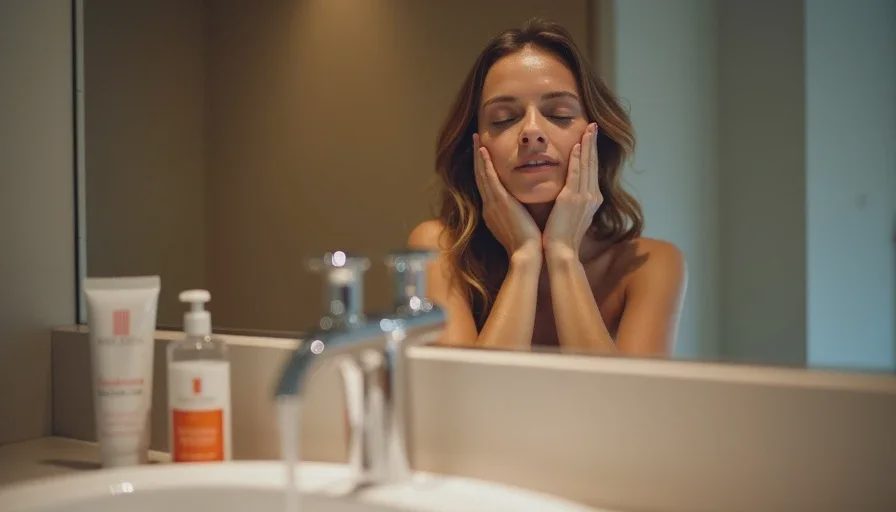
Cleanse with water only, or with a gentle, fragrance-free cleanser you already trust.
If you did not bring your own cleanser, do not use the hotel soap on your face. Hotel soap is formulated for hands and body, not for the delicate skin on the face. It is often alkaline and fragranced, both of which can disrupt the skin barrier. If you have no cleanser, rinse with lukewarm water and pat dry. Do not scrub. Do not use a washcloth. Your hands are gentler.
Apply a barrier-supporting moisturizer.
If you brought your own moisturizer, use it. If you did not, look for a small tube of fragrance-free, ceramide-containing moisturizer at the drugstore. Ceramides support the skin barrier and help it hold onto water. Avoid moisturizers with essential oils, fragrance, or alcohol. Those are common triggers for reactive skin.
Wait two to three minutes before applying makeup.
This allows the moisturizer to absorb fully. If you apply makeup over tacky moisturizer, the makeup will not bond to the skin—it will bond to the moisturizer, which will move. This also gives your skin a moment to settle after cleansing.
Do not exfoliate.
Exfoliation removes dead skin cells, but it also removes some of the protective barrier. On reactive skin in an unfamiliar environment, exfoliation is a risk you do not need to take. Skip it entirely. If your skin feels rough, it is more likely dehydrated than congested. Moisturize instead.
Do not use hotel lotion on your face unless it is fragrance-free and you have patch-tested it.
Hotel lotion often contains fragrance and preservatives that can trigger reactions. If you have no other option, patch-test on your jawline first and wait twenty minutes. If there is no reaction, apply a thin layer. If there is any tingling, redness, or itching, wash it off immediately.
Step 2: Base—Skip Foundation, Use Concealer Only
The base is the highest-risk product for sensitive skin. Foundation covers the most surface area. If it contains a trigger, the reaction will be widespread and visible.
The lowest-risk approach is to skip foundation entirely.
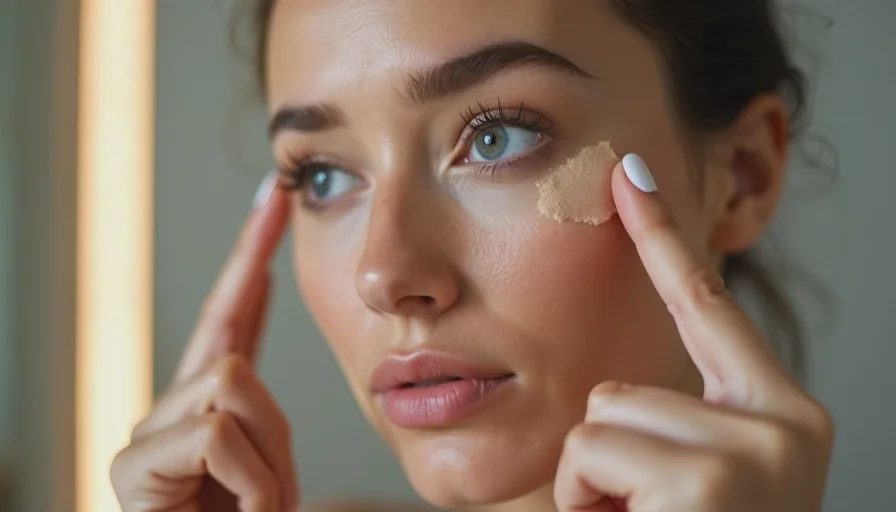
Instead, use concealer only where you need it. Concealer covers a smaller area, which means less product on the skin and less risk of a widespread reaction. A concealer that is one half-step lighter than your skin tone can brighten under-eyes, cover redness around the nose, and spot-fix blemishes without creating a visible line at the jaw.
What to look for in a concealer:
Fragrance-free. Fragrance is one of the most common triggers for contact dermatitis.
Minimal ingredients. The shorter the ingredient list, the fewer potential triggers.
Cream or liquid formula. Stick concealers often contain waxes and preservatives that can be irritating. Cream and liquid formulas are generally gentler.
No "cooling" or "tingling" ingredients. Menthol, camphor, and eucalyptus are common in "refreshing" concealers. They are irritants, not soothing agents.
How to apply: Tap a tiny amount under each eye, around the nose, and on any blemish. Use your ring finger—it applies the least pressure and is the easiest to control. Tap, do not swipe. Swiping drags the product across the skin and can cause micro-irritation.
If you must use a base: Use a tinted moisturizer or a skin tint that you have used before. Do not buy a new base product in a new city on reactive skin. The risk of a reaction is higher than the benefit of coverage. A bare face with targeted concealer looks intentional. A full face of a new foundation that causes a reaction looks like a disaster.
Step 3: Color—One Product, Cheeks and Lips
A face with no color can look flat and unwell. But blush and lipstick are two separate products, which means two separate opportunities for a reaction.
Use one product for both cheeks and lips.
A cream blush or a tinted lip balm in a warm nude or muted rose can be tapped onto the apples of the cheeks and then onto the lips. This gives you coordinated color without adding a second product.
What to look for:
Fragrance-free. This is non-negotiable.
Cream or balm formula. Powders can contain binders and preservatives that irritate reactive skin. Creams and balms are generally gentler.
No shimmer or glitter. Shimmer particles are often coated in oils or metals that can trigger reactions. Choose a matte or satin finish.
A shade that is close to your natural lip color. This is not the time for a bold statement lip. A shade that mimics your natural flush is the lowest-risk choice.
How to apply: Tap a small amount onto the apples of your cheeks with your ring finger and blend upward. Then tap whatever remains on your finger onto your lips. Do not double-dip. Do not apply directly from the tube to your lips and then to your cheeks—that transfers bacteria and can cause irritation.
Step 4: Eye Definition—One Product, Not Two
Eyes are the most sensitive area of the face. The skin is thin, the eyes water easily, and products can migrate into the eye itself. On reactive skin, eye makeup is the highest-risk category after foundation.
Use one eye product, not two.
Choose either a brow pencil or a tubing mascara. Do not use both. The goal is structure, not a full eye look.
If your brows are sparse or light: Use a brow pencil. It defines the structure of the face more than any other single product. Choose a shade one step cooler than your hair color—warm brown brow pencils can pull reddish under office lighting, which looks unnatural. Apply with short, feathery strokes. Do not outline the brow. Fill only where there are gaps.
If your brows are full: Use a tubing mascara. It adds visible length and darkness to the lashes, which makes the eyes appear larger and the face appear more alert. Tubing mascara is the safest option for sensitive eyes because it does not rely on the harsh waxes and solvents that waterproof formulas use. It also removes with warm water and gentle pressure, which means no scrubbing and no irritation.
What to avoid:
Waterproof mascara. The solvents used in waterproof formulas are common eye irritants. Tubing mascara is gentler.
Eyeliner. Eyeliner is applied closest to the eye and is the most likely product to migrate into the eye itself. Skip it entirely.
Eyeshadow. Eyeshadow covers a large area of thin, sensitive skin. Skip it.
Glitter or shimmer. These particles can irritate the eye and the surrounding skin.
How to apply: If using brow pencil, apply with short strokes and blend with the spoolie brush. If using tubing mascara, apply one thin coat. Do not apply a second coat—it increases the risk of flaking and irritation.
Step 5: Setting—Skip Powder, Use a Hydrating Mist
Powder is a common irritant for sensitive skin. It sits on top of the skin, absorbs moisture, and can cause tightness, flaking, and itching. In a new hotel with unfamiliar air quality, powder is a risk you do not need to take.
Skip powder entirely.
If you need to set your makeup, use a hydrating facial mist instead. A light mist adds moisture to the skin and helps the concealer and cream color settle without creating a dry, tight film. Look for a mist that is fragrance-free and contains glycerin or hyaluronic acid. Avoid mists with alcohol, essential oils, or fragrance.
How to apply: Hold the bottle 8–10 inches from your face and mist in a Z-pattern. Do not spray so much that the skin looks wet. One light pass is enough. Let it dry naturally. Do not blot.
The Lowest-Risk Meeting Face Kit
Category | Product | Why It Is Low-Risk |
|---|---|---|
Cleanse | Water only, or your own gentle cleanser | Avoids hotel soap and unfamiliar ingredients |
Moisturize | Fragrance-free ceramide moisturizer | Supports barrier, reduces reactivity |
Base | Concealer only, fragrance-free | Covers small areas, less risk of widespread reaction |
Color | Cream blush or tinted balm, fragrance-free | One product for cheeks and lips, no powder |
Eye | Brow pencil or tubing mascara | One product only, no eyeliner or eyeshadow |
Set | Hydrating facial mist, fragrance-free | No powder, no drying alcohols |
Total: Five products maximum. Everything else is optional and should be skipped.
What to Do If a Reaction Occurs
You applied your makeup. An hour later, your skin is itching, red, or burning. Here is what to do.
1. Do not panic. A reaction is uncomfortable, but it is rarely dangerous. The goal is to reduce the irritation as quickly as possible.
2. Remove the product. Use lukewarm water and a gentle, fragrance-free cleanser. Do not scrub. Do not use a washcloth. If you have micellar water, use it on a cotton pad to gently wipe away the makeup. Do not rub.
3. Apply a barrier cream. If you have a fragrance-free moisturizer with ceramides or squalane, apply a thick layer. This helps repair the barrier and reduces water loss. If you have no moisturizer, a thin layer of petroleum jelly can protect the skin and prevent further irritation.
4. Do not apply more makeup. Adding more product to reactive skin will make the reaction worse. Go to the meeting with a bare face if necessary. A bare face is better than a visible rash.
5. If the reaction is severe—swelling, hives, difficulty breathing—seek medical attention immediately. This is rare, but it is possible. Do not wait.
FAQ: Sensitive Skin and a New Hotel
What if I have no choice but to buy a new base product?
Buy a fragrance-free concealer instead of a foundation. Concealer covers a smaller area and is less likely to cause a widespread reaction. Patch-test on your jawline first. Apply a tiny amount and wait twenty minutes. If there is no reaction, use it only where you need it. If there is any tingling, redness, or itching, do not use it.
What if the hotel water makes my skin sting?
Hotel water can contain chlorine, minerals, or other additives that irritate sensitive skin. Rinse with bottled water if possible. If bottled water is not available, fill a clean cup with tap water and let it sit for an hour—chlorine will dissipate. Use lukewarm water, not hot. Hot water strips oils and worsens irritation. Pat dry with a soft tissue, not a towel. Do not rub.
What if I have rosacea or eczema?
Rosacea and eczema are both barrier-compromised conditions that are highly reactive to new environments. Use the fewest products possible. Cleanse with water only. Moisturize with a fragrance-free ceramide cream. Use only a brow pencil and a tinted lip balm. Skip concealer and blush entirely. A bare face with defined brows and a coordinated lip looks intentional. A face covered in concealer that triggers a flare looks worse than no makeup at all.
What if I have to attend a meeting and my skin is already reacting?
If your skin is already red, itchy, or swollen, do not apply makeup. Makeup will trap irritants against the skin and worsen the reaction. Go to the meeting with a bare face. If you need to look more polished, use a brow pencil and a tinted lip balm only. Those products are unlikely to irritate and they add structure without covering the skin. If the reaction is severe, consider rescheduling the meeting or attending remotely. Your health matters more than a single meeting.
What if I only have ten minutes to get ready?
Cleanse with water. Apply moisturizer. Wait 60 seconds. Apply concealer under the eyes and around the nose. Apply cream color to cheeks and lips. Apply brow pencil or tubing mascara. Mist with hydrating spray. Total time: under ten minutes. The result is a face that reads as awake, intentional, and not visibly distressed.
What if I forgot my own products and have to use hotel amenities?
Hotel amenities—soap, lotion, shampoo, conditioner—are formulated for general use, not for sensitive facial skin. Do not use hotel soap on your face. If you have no cleanser, rinse with water only. If you have no moisturizer, use a tiny amount of hotel lotion on your jawline and wait twenty minutes to see if it triggers a reaction. If it does not, apply a thin layer. If it does, rinse it off and use nothing. A bare, slightly dry face is better than a face covered in a product that causes a reaction.
Can I use the hotel's shampoo or conditioner as a makeup remover?
Conditioner, yes—it breaks down pigment without stripping the skin. Shampoo, no—it is formulated to strip oils from hair and will leave your face tight and irritated. If you have no makeup remover, use lotion on a tissue to break down the concealer, then wash with lukewarm water. Do not rub.
What if my skin reacts to the hotel bedding?
Hotel sheets and pillowcases are washed with industrial detergents that may contain fragrances or preservatives. Bring your own pillowcase if you know you are sensitive. If you did not bring one, place a clean T-shirt or scarf over the pillow. Sleep on your back if possible to minimize contact between your face and the bedding. If you wake up with a reaction, wash your face with lukewarm water and apply a barrier cream.
What if I have to share a hotel room and cannot control the air quality?
Air conditioning and heating systems can circulate dust and allergens. Keep the room temperature moderate. Extreme temperatures—very hot or very cold—can trigger reactivity. If the air is very dry, place a wet towel over a chair or radiator to add moisture to the air. If the air is damp, run the air conditioning on a low setting to reduce humidity. Do not use a humidifier unless you know it is clean—dirty humidifiers can spread mold and bacteria.
What if my eyes water constantly in the new environment?
Watery eyes are a common reaction to dry air, dust, or allergens. Use lubricating eye drops before applying eye makeup. If your eyes water after applying makeup, do not wipe them. Press a tissue gently against the closed eye to absorb the moisture. If the watering is severe, skip eye makeup entirely. A bare eye with a defined brow is better than mascara running down your face.

No notes yet — write the first one.