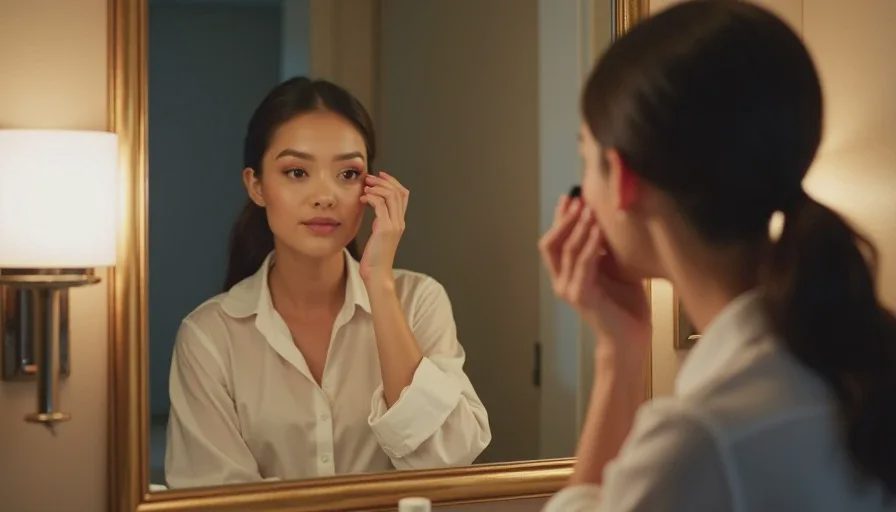
The hotel bathroom mirror said everything was fine. The office bathroom mirror said everything was wrong.
This is the full failure report for a three-product kit that was applied in a hotel bathroom at 7:15 AM, appeared balanced and natural under that lighting, and then visibly failed within minutes of walking into a client office under overhead fluorescent lighting. The purpose of this report is not to criticize the products. It is to document the exact lighting conditions that caused a kit to read one way in one room and a different way in another—and to explain why this happens to almost everyone who applies makeup in a hotel bathroom.
The Climate Conditions
Location: Chicago, Illinois (November)
Outdoor conditions at time of application (7:15 AM):
Temperature: 1°C (34°F)
Dew point: -4°C (25°F)
Relative humidity: 58%
Wind: 14 mph
Conditions: Overcast, light snow flurries
Indoor conditions — hotel bathroom (7:15–7:25 AM):
Temperature: 22°C (72°F)
Relative humidity: 28%
Lighting: Two wall sconces flanking the mirror, warm white (approximately 2700K), estimated 150–200 lux at face level
Mirror: Standard flat mirror, no magnification
Indoor conditions — client office (8:45 AM onward):
Temperature: 21°C (70°F)
Relative humidity: 22%
Lighting: Overhead recessed fluorescent panels, cool white (approximately 4100K), estimated 500–700 lux at face level
Additional light: Large windows on the north side, overcast daylight (approximately 6500K)
The critical difference: The hotel bathroom lighting was warm (2700K), dim (150–200 lux), and directional (from the sides). The office lighting was cool (4100K), bright (500–700 lux), and overhead. The combination of a 1400K color temperature shift and a 3–4x increase in brightness is what caused the same face to read two different ways within 90 minutes.
The Three-Product Kit
Product 1 — Base: Maybelline Dream Fresh BB Cream, shade Medium/Deep
Formula type: Water-based tinted moisturizer with SPF 30
Finish: Dewy/natural
Coverage: Sheer to light
Product 2 — Color: e.l.f. Monochromatic Multi Stick, shade Glistening Peach
Formula type: Cream-to-powder stick
Use: Cheeks and lips
Finish: Satin with slight shimmer
Product 3 — Eye: Maybelline Lash Sensational Sky High Waterproof Mascara, shade Very Black
Formula type: Wax-based waterproof
Use: Lashes only
Finish: Matte black
Total products: Three. No concealer, no powder, no brow product, no setting spray.
Reason for the kit: This was a two-day business trip with carry-on luggage only. The three-product constraint was deliberate. The goal was a face that read as "awake and professional" without requiring a full routine.
The Prep and Application
Skincare prep (7:00 AM):
Cleansed with CeraVe Hydrating Facial Cleanser
Applied CeraVe Daily Moisturizing Lotion
Waited 3 minutes for absorption
Application (7:15 AM):
BB cream: Applied with fingers. Three dots on forehead, each cheek, chin. Blended outward. One thin layer. No second layer.
Multi stick: Applied to apples of cheeks with the stick, blended upward with ring finger. Then tapped remaining product onto lips.
Mascara: One coat. Wiggle at base, pull up.
Total application time: 4 minutes.
Time out the door: 7:25 AM.
Time entering client office: 8:45 AM.
The Failure Timeline
0–30 Minutes (7:25–7:55 AM): Hotel Room and Taxi
Everything looked balanced. The BB cream evened out redness without looking heavy. The multi stick added a warm flush to the cheeks and a coordinated tint to the lips. The mascara defined the lashes without clumping. Under the hotel bathroom's warm sconce lighting, the skin looked even, the cheeks looked naturally flushed, and the overall effect was "healthy and awake."
In the taxi, under overcast daylight through the windows, the face still looked acceptable. The BB cream had a slight dewiness that read as "hydrated." The blush was visible but not obvious. No failure signals yet.
45–60 Minutes (8:00–8:15 AM): Lobby and Elevator
The first subtle signal appeared in the elevator. The overhead lighting in the elevator was cooler and brighter than the hotel bathroom. The BB cream, which had looked even and natural in the warm bathroom light, now looked slightly gray around the jawline and the perimeter of the face. The dewy finish, which had read as "hydrated" under warm light, now read as "slightly shiny" under the cooler overhead light.
The multi stick on the cheeks looked slightly more pink than it had in the hotel. The warm peach shade, which had blended into the skin under 2700K lighting, now pulled cooler and more visible against the cooler 4100K lighting. It was not obviously wrong. It was slightly off.
60–90 Minutes (8:15–8:45 AM): Client Office, Overhead Fluorescent
The failure was fully visible within five minutes of sitting down in the conference room.
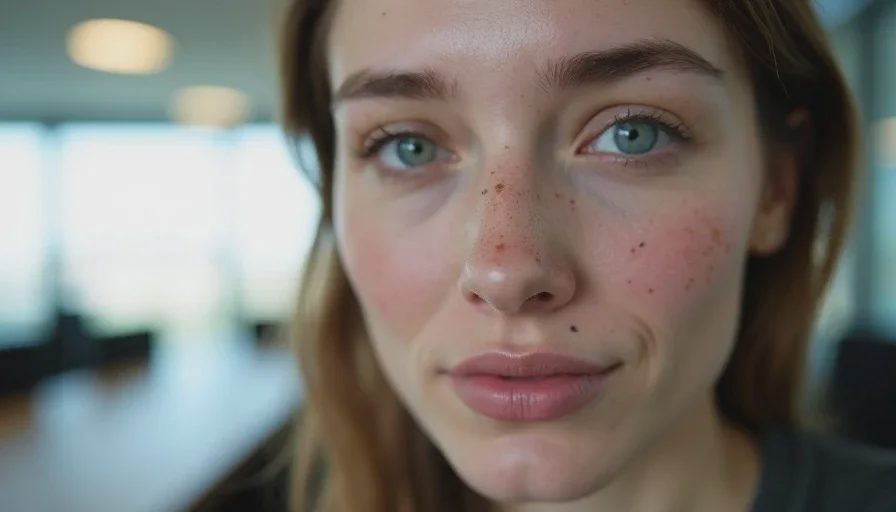
The base: The BB cream had separated slightly around the nose and the chin. Under the bright overhead fluorescent lighting, the separation was visible as a faint, uneven texture — not sliding off, but no longer sitting smoothly. The shade, which had looked "Medium/Deep" in the warm bathroom light, now read as slightly ashy against the neck. The dewy finish reflected the overhead light directly, creating a visible shine on the forehead and nose that read as "oily," not "glowing."
The color: The multi stick on the cheeks had faded significantly by 8:45 AM. What remained was a faint, uneven patch of pink on the left cheek (the side facing the window) and almost nothing on the right cheek. Under the office lighting, the asymmetry was visible. The shimmer in the formula, which had been invisible in the warm hotel light, now caught the overhead fluorescent light and created tiny, visible sparkles on the cheekbone. The lips had lost most of the color and looked dry.
The eye: The mascara had flaked slightly onto the under-eye area. Two small black specks were visible on the left cheekbone. The wax-based waterproof formula, which had held up fine in the cold outdoor air, began to flake in the dry, heated office environment. The flakes were not obvious from a distance, but they were visible up close and in the bright overhead light.
Overall impression: The face looked tired and slightly uneven. The base looked ashy and shiny. The blush looked patchy and sparkly. The mascara had flaked. None of these failures had been visible in the hotel bathroom mirror.
The Failure Analysis
Primary Failure Mode: Color Temperature Shift
The hotel bathroom sconces were warm white (approximately 2700K). The office overhead panels were cool white (approximately 4100K). This is a difference of roughly 1400 Kelvin — a significant shift in the color of light.
What warm light does: Warm light (2700–3000K) has a higher concentration of red and yellow wavelengths. It makes warm-toned products (peach blush, warm beige foundation) look more saturated and more natural. It also softens the appearance of redness, uneven texture, and dark circles because the red wavelengths blend into the warm ambient light. This is why hotel bathrooms are flattering. They hide flaws.
What cool light does: Cool light (4000–5000K) has a higher concentration of blue wavelengths. It makes warm-toned products look less saturated and more pink or gray. It also reveals texture, redness, and unevenness because the cool wavelengths reflect off the surface of the skin and create contrast. This is why office lighting is unforgiving. It reveals everything the warm light hid.
The specific failure: The BB cream in shade Medium/Deep was a warm-toned formula. Under 2700K light, it read as balanced and natural. Under 4100K light, the warm tones were suppressed, and the formula read as slightly ashy — the classic "gray cast" that occurs when a warm foundation is viewed under cool light. The multi stick in Glistening Peach was a warm peach shade. Under warm light, it blended into the skin. Under cool light, the peach shifted toward pink, and the shimmer particles became visible.
Secondary Failure Mode: Light Intensity and Texture Reveal
The hotel bathroom was dim — approximately 150–200 lux. The office was bright — approximately 500–700 lux. This is a 3–4x increase in brightness.
What dim light does: Dim light reduces the contrast between the skin and the makeup. It softens the appearance of texture, pores, separation, and flaking. A face that looks smooth in dim light may look textured in bright light. This is why makeup applied in a dim bathroom often looks heavier or more uneven in daylight.
What bright light does: Bright light increases contrast. It reveals every uneven patch, every flake, every separated area of foundation, every pore, and every line. The BB cream that looked smooth in the hotel bathroom showed visible separation around the nose in the bright office. The mascara flakes that were invisible in dim light became visible black specks in bright light.
Tertiary Failure Mode: Directional vs. Overhead Lighting
The hotel bathroom sconces were positioned on either side of the mirror, at face level. This is directional lighting — it illuminates the face from the sides, creating soft shadows that define the cheekbones and jawline. It is flattering because it mimics natural daylight at sunset.
The office lighting was overhead and diffuse — it illuminated the face from above, creating shadows under the eyes, under the nose, and along the jawline. Overhead lighting is unflattering because it emphasizes under-eye circles, nasolabial folds, and any texture on the forehead and nose.
The specific failure: The dewy finish of the BB cream, which looked "hydrated" under side lighting, looked "shiny" under overhead lighting because the overhead light reflected directly off the surface of the skin. The multi stick shimmer, which was invisible under side lighting, became visible under overhead lighting because the light caught the particles at a different angle.
Contributing Factor: The Missing Products
The three-product constraint meant there was no concealer, no powder, and no brow product. Each of these missing products would have addressed one of the failures:
Concealer would have covered the under-eye darkness that the overhead lighting emphasized.
Powder would have controlled the shine that the overhead lighting revealed.
Brow product would have added structure to the face that the flat overhead lighting flattened.
The three-product kit was designed for efficiency. It was not designed for the lighting conditions of a modern office.
What Would Have Changed the Outcome
1. Apply Makeup Under Cool Light, Not Warm Light
The simplest fix: do not apply makeup in a hotel bathroom with warm sconces. Apply it near a window with daylight, or bring a small daylight mirror. A daylight mirror (approximately 5000–6500K) simulates the lighting conditions of most offices. If you can see your face under daylight or cool white light before you leave the room, you will see the failures before they happen.
Practical alternative: Apply makeup in the hotel room near a window, even if the window faces a parking garage. Overcast daylight (6500K) is closer to office lighting than warm bathroom sconces (2700K).
2. Choose a Base With a Neutral or Cool Undertone
The BB cream in Medium/Deep was a warm-toned formula. Under warm light, it looked balanced. Under cool light, it looked ashy. A neutral or cool-toned base would have looked more consistent across both lighting environments. If you are traveling to a business environment with overhead fluorescent lighting, choose a base with a neutral undertone — not warm.
3. Choose a Matte or Satin Blush, Not Shimmer
The Glistening Peach multi stick contained shimmer particles. Shimmer is invisible under warm, dim, side lighting. It is highly visible under cool, bright, overhead lighting. For a business trip, choose a matte or satin blush without shimmer. The color will read consistently across lighting environments, and there will be no particles to catch the overhead light.
4. Add a Fourth Product: Translucent Powder
The three-product constraint was the root cause of the shine failure. A small compact of translucent powder would have controlled the shine on the T-zone without adding significant weight or space. The powder would have been applied after the BB cream and before entering the office, and it would have mattified the areas that the overhead lighting revealed as shiny.
Space cost: A slim pressed powder compact takes up less space than a second lip product. The trade-off is worth it for a business trip.
5. Add a Fifth Product: Brow Pencil
The overhead lighting flattened the face. A brow pencil would have added structure and definition without requiring a full eye look. The brow pencil is the single most space-efficient product for adding structure to the face. It takes up less space than a mascara and does more structural work under flat overhead lighting.
6. Blot Before Entering the Office
The dewy finish of the BB cream was the primary cause of the shine failure. Blotting the T-zone with a tissue immediately before entering the building would have removed surface oil and reduced the shine without removing pigment. The blot would have taken 10 seconds and would have made the base look matte under the overhead lighting.
The Repair Protocol (What Was Done at 9:00 AM)
The meeting started at 9:15 AM. There was no time to redo the full face.
What was done:
Excused to the restroom. Pressed a dry tissue against the forehead and nose to remove surface shine. Did not wipe.
Used a cotton swab to gently remove the two mascara flakes from the cheekbone.
Tapped a small amount of the multi stick onto the right cheek to balance the asymmetry from the left cheek. Blended with ring finger.
Applied a small amount of lip balm to the lips to address the dryness.
Did not reapply BB cream. Did not add powder. Did not add concealer.
Result: The face was presentable, but not polished. The base still looked slightly ashy under the office lighting. The shine was reduced but not eliminated. The blush was more balanced, but the shimmer was still visible under overhead light. The mascara flakes were gone.
Time to repair: 3 minutes.
FAQ: Why a Kit Fails Under Office Lighting
Why did my makeup look fine in the hotel but wrong in the office?
The hotel bathroom and the office have different lighting. Hotel bathrooms typically use warm white bulbs (2700–3000K) at low intensity (150–200 lux). Offices typically use cool white fluorescent panels (4000–5000K) at high intensity (500–700 lux). Warm, dim light hides flaws and makes warm-toned products look natural. Cool, bright light reveals flaws and makes warm-toned products look ashy or gray. The same face can look two different ways under these two lighting conditions.
What is the ideal lighting for applying makeup?
Daylight (5000–6500K) is the most neutral. It is closest to the lighting conditions of most offices, most outdoor environments, and most public spaces. If you cannot apply makeup near a window, use a daylight mirror or a portable daylight lamp. These simulate 5000–6500K light and reveal the same flaws that office lighting will reveal.
How do I check the color temperature of my hotel bathroom?
You cannot check it precisely without a light meter, but you can estimate it. Warm light (2700–3000K) looks yellow or orange. Cool light (4000–5000K) looks white or blue-white. Daylight (5000–6500K) looks neutral to slightly blue. If the bathroom light looks yellow, it is warm. If it looks white or slightly blue, it is cool. If it looks like the light outside, it is daylight.
What is the CRI of hotel and office lighting?
CRI (Color Rendering Index) measures how accurately a light source renders colors on a scale of 0 to 100. Daylight has a CRI of 100. Most office fluorescent lighting has a CRI of 60–80. Hotel bathroom lighting often has a CRI of 80–90. A low CRI means the light does not render colors accurately — warm tones may look warmer, cool tones may look cooler, and undertones may shift. High CRI (90+) lighting is more accurate and more predictable.
Why did my base look ashy under office lighting?
The base was a warm-toned formula. Under warm light, the warm tones were amplified, and the base looked balanced. Under cool light, the warm tones were suppressed, and the base looked gray or ashy. This is a common problem with warm-toned foundations in cool-lit environments. To avoid it, choose a neutral or cool-toned base if you will be in an office environment.
Why did my blush look patchy under office lighting?
The blush faded unevenly, partly because the cream formula absorbed into the skin at different rates on different parts of the cheek, and partly because the shimmer particles caught the overhead light and created visible sparkles. A matte or satin blush without shimmer would have read more consistently across lighting environments.
Why did my mascara flake in the office but not in the hotel?
The hotel bathroom was warm and relatively humid (28% relative humidity). The office was cool and dry (22% relative humidity). The wax-based waterproof mascara was flexible in the warmer, more humid environment but became brittle in the dry office air. The brittleness caused flaking. A tubing mascara would have been more flexible across both environments and less likely to flake.
Can I fix ashy foundation without removing it?
You can reduce the ashiness by adding warmth back to the face. A warm-toned cream blush, a bronzer, or a warm-toned lip balm can counteract the gray cast. In this case, the multi stick was warm-toned, and reapplying it to the cheeks helped balance the overall face. But the underlying base still read as slightly ashy. The only complete fix is to remove the base and reapply with a neutral or cool-toned formula.
Should I carry a daylight mirror when I travel?
A small daylight mirror (approximately 5000–6500K) takes up very little space and allows you to see your face under the same lighting conditions as most offices. If you travel frequently for business, a daylight mirror is one of the highest-value travel accessories you can carry. It prevents the exact failure documented in this report.
What is the ideal three-product kit for office lighting?
If the lighting is cool and bright, the ideal three-product kit is: (1) a neutral-toned base with a matte or satin finish; (2) a matte or satin cream blush in a warm nude or muted rose; (3) a brow pencil or tubing mascara. No shimmer. No dewy finish. No warm-toned foundation. The base should be neutral, the blush should be matte, and the eye product should be flexible.
What if I only have three products and no powder?
If you have no powder, blot the T-zone with a tissue before entering the office. Blotting removes surface oil and reduces shine without adding a product. If you have no concealer, use the base itself in a slightly heavier layer under the eyes and tap it in with your ring finger. If you have no brow product, use the mascara wand to lightly coat the brows with a small amount of mascara — this is not ideal, but it adds structure. If you have no setting spray, skip it. In dry office air, a setting spray can add moisture that the dry air will pull away, creating a tight, uncomfortable film.


No notes yet — write the first one.